When Electoral Fraud Becomes Constitutional Fraud—The Case That Tests India’s Democratic Values
By a Legal Correspondent: Rohann kumar K
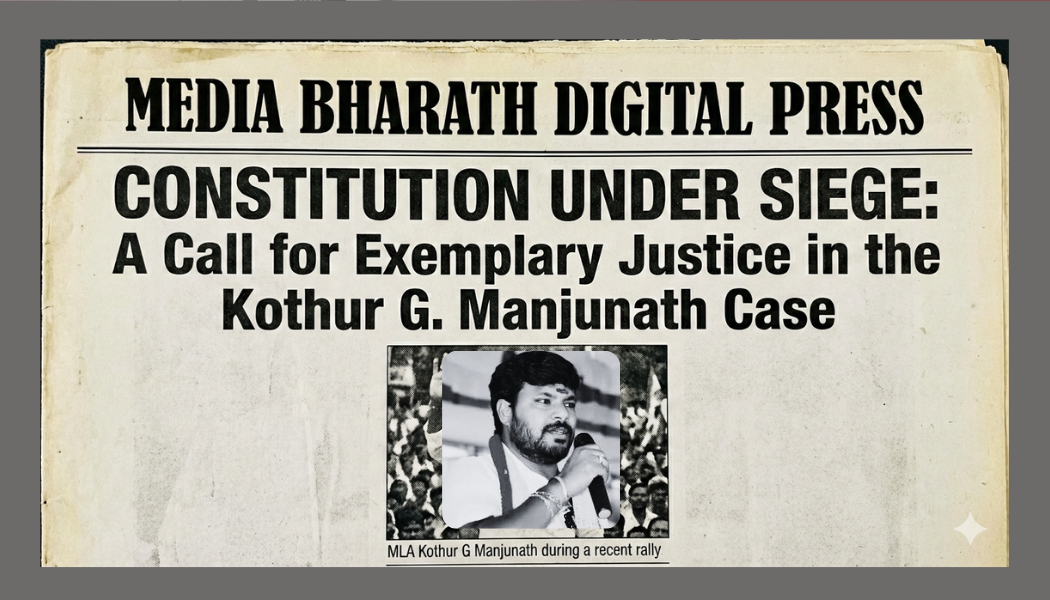
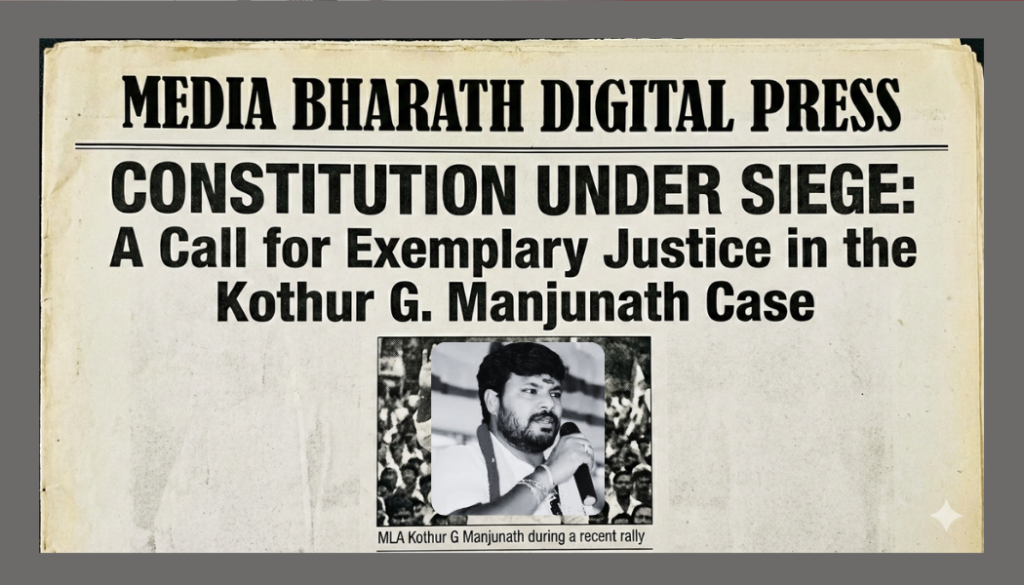
The case of Kothur G. Manjunath, the Congress MLA from Kolar, Karnataka, stands as a stark reminder that in a democracy, no individual—no matter how high their position—is above the rule of law. What began as an election petition in 2012 has evolved into a constitutional crisis that demands not just punishment, but an exemplary demonstration of the supremacy of the Constitution itself.
THE CRIME: Fraud on the Constitution Itself
Kothur G. Manjunath did not commit an ordinary forgery. He did not merely obtain a fake document to secure a job or gain personal benefit. He committed something far more sinister—he committed a fraud on the Constitution of India.
In 2012, Manjunath submitted a caste certificate claiming to belong to the “Budaga Jangama” community, classified as a Scheduled Caste (SC). Armed with this false document, he contested the election from the Mulbagal constituency—a seat reserved for candidates genuinely belonging to SC communities. He won that election, defeating other candidates and depriving a legitimate SC candidate of their constitutional right to contest from a reserved seat.
Not only did he contest and win; he served as an MLA, enjoyed the perks of legislative office, participated in governance, and benefited from the position he had no right to hold. All this, while standing on the pedestal of a fabricated identity.
The Karnataka High Court, in its December 2024 order, crystallized the gravity of this offense: “It is a clear case that the petitioner contested the election on a caste certificate, which was on the face of it false and became a law maker even, by stealing away a constituency that was meant for a person genuinely belonging to a scheduled caste.”
This is not merely a crime. This is a violation of the Constitution’s soul.
THE CONSTITUTIONAL BREACH
The Indian Constitution, through Articles 15(4) and 16(4), grants reservations for Scheduled Castes and Scheduled Tribes to remedy centuries of social injustice and discrimination. These reservations are not favors or handouts; they are constitutional mandates designed to ensure substantive equality and social justice.
When Manjunath used a false caste certificate to secure a reserved seat, he did not just cheat an individual candidate—he cheated the Constitution itself. He undermined the very foundational principle of social justice that the Constituent Assembly enshrined in our Constitution.
The Questions That Demand Answers:
- Who Lost What? A genuine SC candidate, who would have been the rightful legislator, lost their opportunity to serve the people. The people of Mulbagal lost the representation they deserved.
- Whose Rights Were Violated? The rights of all SC communities whose constitutional protections Manjunath mocked. The rights of the people to honest governance.
- What Message Does This Send? If Manjunath faces lenient punishment, the message is clear: circumvent constitutional protections, usurp positions meant for the marginalized, and you may get away with it. This is a recipe for the destruction of constitutional democracy.
THE EVIDENCE: A Damning Record
The evidence against Manjunath is overwhelming and uncontested:
The Caste Verification Committee’s Report (2021): The District Caste Verification Committee (DCVC) meticulously examined Manjunath’s claim to Budaga Jangama caste. The committee found:
- No documentary evidence supporting his claim to Budaga Jangama caste
- His customs, food habits, dress, and ceremonial practices do not match those of the Budaga Jangama community
- He actually belongs to the “Byragi” community, classified as OBC, not SC
The High Court’s Verdict (2018): The Karnataka High Court nullified his 2012 election, recognizing that the caste certificate was false.
The Supreme Court Confirmation (2020-2025): The Supreme Court, after examining the matter, confirmed that a District Caste Verification Committee should determine his actual caste and that criminal proceedings should continue.
The High Court’s Recent Order (December 24, 2024): Justice M. Nagaprasanna rejected Manjunath’s plea to quash criminal proceedings, stating the crime “fringes on the borders of fraud on the Constitution.”
There is no ambiguity here. There is no gray area. The evidence is crystalline.
APPLICABLE LEGAL PROVISIONS: What Punishment Should He Face?
Under Indian law, multiple provisions apply to Manjunath’s crime:
1. Section 468 IPC – Forgery for the Purpose of Cheating
- Punishment: Imprisonment up to 7 years and fine
- Application: Manjunath used a forged caste certificate with the explicit intent to cheat the electoral process and secure a seat he had no right to contest from
2. Section 471 IPC – Using Forged Document as Genuine
- Punishment: Same as the forgery charge (up to 7 years)
- Application: He knowingly used the false caste certificate throughout his electoral campaign and while serving as MLA
3. Section 198 IPC – Using False Certificate
- Punishment: Same as punishment for giving false evidence
- Application: The caste certificate is a document that forms the basis of electoral eligibility
4. SC/ST Prevention of Atrocities Act, 1989
- Enhanced Punishment Provisions for crimes involving SC/ST benefits
- Application: By using a false SC certificate, he deprived genuine SC candidates of constitutional protections and opportunities reserved for them
Precedent: A Case for Severe Punishment
In February 2024, a session court in Indore convicted a police constable of 10 years imprisonment and ₹4,000 fine for obtaining his job using a fake caste certificate. The constable had done what Manjunath did—obtained a position using fraudulent SC documentation.
Why should Manjunath—who obtained not just a job but a legislative seat, who held public office while fraudulently denying a genuine SC candidate their constitutional right—receive less punishment?
THE CURRENT STATUS: A Case That Must Not Stall
As of January 14, 2026:
- Writ Appeal Pending: The matter is before the Karnataka High Court Division Bench with the next hearing on January 14, 2026. The appeal has 19 noted defects that have not been rectified, and Manjunath has not been regularly appearing for hearings.
- Criminal Investigation: The Karnataka High Court, in December 2024, directed the police to expeditiously complete the investigation. However, six years have already passed since the FIR was registered in 2018, with virtually no investigation conducted while the matter remained pending in higher courts.
- Supreme Court Stance: The Supreme Court has made clear that:
- The criminal case should proceed unobstructed
- Manjunath’s plea to quash the case has been dismissed
- The High Court is free to decide the writ appeal on its merits
The time for prolonged legal delays must end. Justice delayed is justice denied, and in this case, continued delays only mock the Constitution and the marginalized communities that the reservations were meant to protect.
WHY THIS CASE MATTERS BEYOND KOLAR
This case is not merely about one MLA from a small district in Karnataka. It is about the integrity of Indian democracy itself. Consider these implications:
1. Electoral Sanctity
If a person can fraudulently contest elections using false documents and face minimal consequences, what does this say about the electoral process? Reserved seats exist for a constitutionally sanctioned purpose. When that purpose is subverted, the electoral system loses credibility.
2. Social Justice Framework
The Constitution’s commitment to social justice through reservations is only meaningful if it is protected from fraud. Every fraudulent usurpation of a reserved seat is an attack on the most vulnerable communities.
3. Constitutional Authority
The Constitution is not merely a legal document; it is a social contract between the state and its citizens. When public officials violate the Constitution with impunity, the document loses its binding authority. Citizens lose faith in constitutional protections.
4. Rule of Law
In a constitutional democracy, the rule of law is paramount. No one—not a legislator, not a minister, not a bureaucrat—can be above the law. If Manjunath escapes with light punishment, what message does this send to millions of citizens about the effectiveness of law?
THE DEMAND FOR EXEMPLARY JUSTICE
The judiciary now faces a choice that will define the credibility of Indian justice:
Option 1: Lenient Punishment
- Minimum sentence, quick release on appeal
- Message sent: Constitutional fraud is a minor offense
- Result: Encouragement for more such offenses; erosion of public faith in the Constitution
Option 2: Exemplary Punishment
- Conviction under stringent provisions (Section 468, SC/ST Act)
- Sentence that reflects the gravity of constitutional fraud
- Message sent: The Constitution is supreme; no one is above it
- Result: Deterrence for future offenders; restored faith in constitutional safeguards
The choice is clear.
Based on legal precedent (the 10-year sentence for a police constable), the severity of the crime (constitutional fraud, not just administrative irregularity), and the need for deterrence, Kothur G. Manjunath must face a sentence of not less than 7-10 years imprisonment, along with substantial fines and permanent disqualification from holding elected office.
A MESSAGE FROM THE COURTS TO THE PEOPLE
Every court order in this case—from the trial courts to the High Court to the Supreme Court—must carry a singular message:
“We are committed to the Constitution. We recognize that Kothur G. Manjunath’s act was not an individual crime but a constitutional crime. The Constitution is not just words on paper; it is the binding contract of our democracy. No one—absolutely no one—has the right to violate it for personal gain. Today, we punish this violation severely, so that tomorrow, no citizen dares to think that the Constitution can be defrauded.”
This message is not just for Manjunath. It is for every legislator, administrator, and citizen who might contemplate subverting the constitutional framework for personal benefit.
THE STAKES FOR DEMOCRACY
The Supreme Court of India, in numerous judgments, has held that fraud on the Constitution is the gravest offense a public official can commit. In this case, all the constitutional machinery has worked—the electoral courts found the truth, the High Court annulled the election, the verification committee confirmed the facts, and now the criminal courts are examining guilt.
But the final chapter—sentencing and punishment—must be commensurate with the crime.
If courts fail to deliver exemplary justice here, the message to millions of Indian citizens will be: “The Constitution protects some, but not all equally. If you are powerful enough to secure high office fraudulently, the consequences are bearable.”
This outcome is unacceptable in a constitutional democracy.
CONCLUSION: Constitution Is Above All
The Indian Constitution’s Preamble promises justice—social, economic, and political. The reservations are not charity; they are constitutional commitments to correct historical injustices.
Kothur G. Manjunath’s crime is that he attempted to transform this constitutional commitment into a tool of personal ambition. He mocked the Constitution, undermined social justice, deprived a legitimate candidate of their right, and compromised the integrity of democratic institutions.
The judiciary now has an opportunity to reaffirm a fundamental principle:
The Constitution is above all. No person, no matter their position, is above the law. When constitutional values are violated, the punishment must be severe and exemplary. This is the price of maintaining democracy in a vast, diverse, and deeply unequal society.
If the courts deliver justice with the severity it demands, Manjunath’s case will become a watershed moment—a moment when India’s constitutional system demonstrated that it has the will and the power to protect its own integrity.
Conversely, if courts allow this to become just another case with a soft conclusion, democracy itself will be the victim.
The time for judgment is now. The time for action is now. The time to show that our Constitution is truly supreme is now.
The case is pending before the Karnataka High Court, with the next hearing scheduled for today January 14, 2026. All eyes are on the judiciary to deliver justice that will restore faith in constitutional democracy.
About The Author