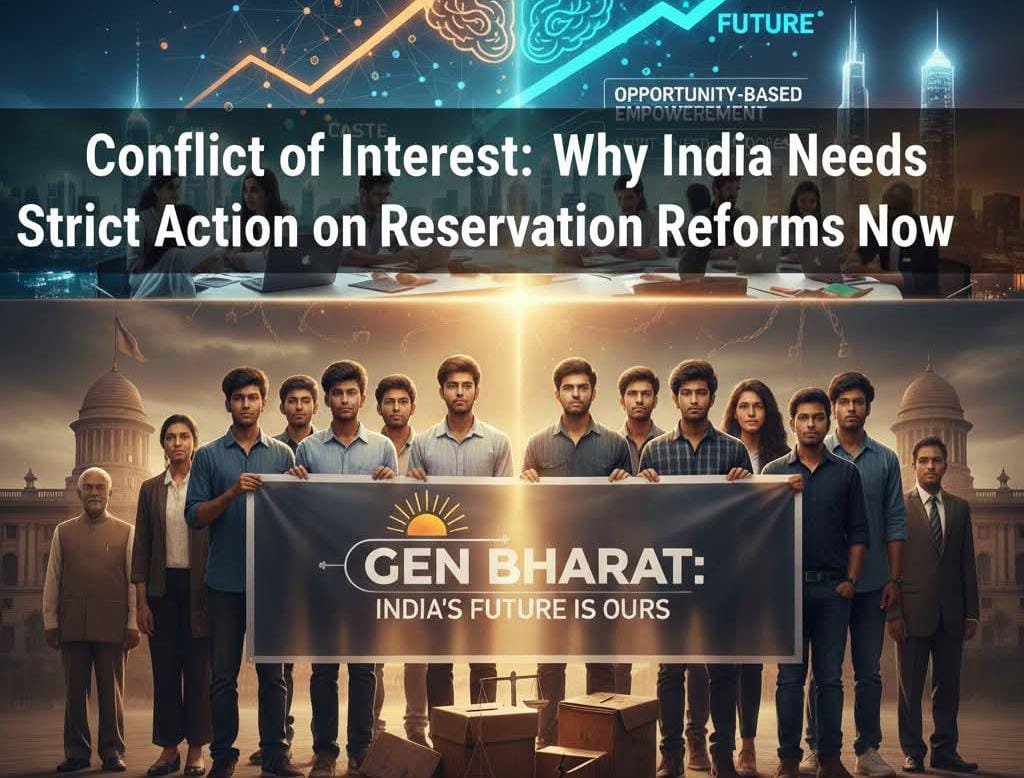
Conflict of Interest: Why India Needs Strict Action on Reservation Reforms Now
By Rohann Kumar K
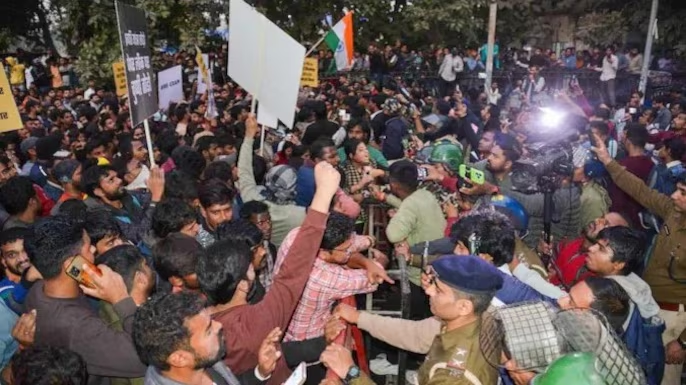
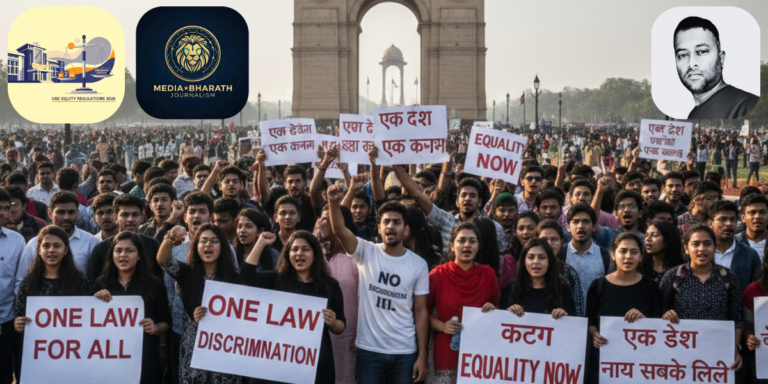
NEW DELHI, Dec 19, 2025 — As India marches toward its centenary of independence, a new demographic force known as Gen Bharat is demanding a fundamental shift in how the nation is governed. This generation, born into a digital and rapidly globalizing India, is raising a critical voice against the “misguided” implementation of reservation policies and the persistent influence of “past leaders and organizations” over their future.
The Conflict of Interest: Empowerment vs. Entitlement
The core of the current debate lies in a perceived conflict of interest. While the original intent of the Indian Constitution was to provide a temporary ladder for the “needful classes” to overcome historical injustices, many in the younger generation argue that the system has been hijacked by political interests.
- Political Compulsions: The youth argue that modern “NETAS(Politicians)” use reservations as a tool for vote-bank politics rather than genuine social engineering.
- The “Creamy Layer” Loophole: Benefits are often captured by the relatively affluent within reserved categories, leaving the truly marginalized in the same state they were decades ago.
- Brain Equality: Gen Bharat advocates for a system where reservations are limited to ensuring “brain equality”—providing the necessary literacy, resources, and environment for the needy to prepare for competition, rather than bypassing the competition itself.
Opinion | Gen Bharat: Reservations were designed to create equality of opportunity, but many young Indians feel the policy is now being misdirected in ways that weaken merit-based competition and long-term national strength. This article argues for reforms that keep support for the truly needful while ensuring the future is shaped by today’s youth—not entrenched political interests.
A Vision for “Competition-Ready” Support
The aspiration of the modern Indian youth is not to abolish support, but to redefine it. The focus is shifting from outcome-based quotas to opportunity-based empowerment.
| Aspect | The Current Model (Past-Centric) | The Gen Bharat Model (Future-Centric) |
| Primary Goal | Compensating for historical discrimination. | Building national strength and stability. |
| Selection Criteria | Caste-based identity. | Need-based support + Merit-based selection. |
| Support System | Seat reservation in jobs/colleges. | Mandatory literacy and competitive training. |
| Decision Makers | Political parties and old organizations. | Youth-led policy and administrative reform. |
The consensus among young leaders is that the government must provide compulsory and mandatory support—including high-quality literacy programs and respectful environments—to ensure that every citizen, regardless of background, is equipped to serve the nation’s administration through fair competition.
Moving Beyond Historical Accounting
One of the most provocative stances taken by Gen Bharat is the refusal to define the future solely by “counting history.” While acknowledging that discrimination existed, the youth point to a modern reality where school, college, and administrative environments are increasingly merit-blind.
“We cannot drive a car by only looking at the rearview mirror. If there are no active cases of discrimination in our schools and offices, why are we still using the metrics of the 1950s to decide the careers of 2025?” — An excerpt from youth dialogue forums.
The Mandate for Youth-Led Decisions
The article concludes with a firm call to action: The future of the next generation must be decided by the youth of this country. The generation currently entering the workforce insists on a “strict implementation” of policies that prioritize national stability over caste-based divisions. They believe that by providing the “needful” with the tools to compete equally, India will cultivate a responsible citizenry capable of building a “Strong India.”
Rohann Kumar K emphasizes that the time for comparing past wounds has passed; the time for acting on present potential is here.
About The Author