The Aravalli Test: Why Climate Action Fails Without ‘Equality Criteria Analysis’ (ECA)
Date: January 1, 2026
Policy Authority: Samaanathe International Foundation
Topic: Climate Justice, Carbon Markets, and Strategic Frameworks
The destruction of the Aravalli Hills is not merely an environmental crime; it is a structural failure of equity. While the Supreme Court of India battles over definitions of “forests” and “hills,” a deeper crisis is unfolding—one that standard environmental laws have failed to address.
Samaanathe International Foundation argues that the Aravalli crisis persists because we are measuring “development” with broken tools. To solve this, we must apply a higher standard: the Equality Criteria Analysis (ECA). This proprietary framework does not just ask if a project is profitable; it asks who pays the price for that profit.
I. The Diagnosis: Applying ECA to the Aravalli Crisis
The Equality Criteria Analysis (ECA) is a high-level auditing framework designed by Samaanathe to measure the true cost of human activity. It operates on three pillars: Ecological Balance, Social Equity, and Intergenerational Justice.
When we run the Aravalli situation through the ECA framework, the results are damning:
1. The Inequality of Resource Extraction
- The Violation: Mining in the Aravallis extracts resources (stone/sand) for the construction of elite high-rises in Gurugram and Delhi.
- The ECA Verdict: FAILED. The benefit goes to the top 1% (developers and luxury homeowners), while the cost (loss of groundwater, toxic air) is borne by the bottom 99% and local villagers.
- The Climate Reality: The rich can buy air purifiers and water tankers; the poor cannot. The destruction of the Aravallis is an act of climate apartheid.
2. The Intergenerational Deficit
- The Violation: Puncturing the Aravalli aquifers provides water for today’s consumption but destroys the recharge zone for tomorrow.
- The ECA Verdict: FAILED. This is “temporal inequality.” We are stealing water from the generation of 2050 to fuel the greed of 2026.
- The Risk: By the time the infants of today become adults, the “Water Tower” of North India will be dry.
II. The Solution: High-Value Carbon Credit Programmes through ECA
The Aravalli range has the potential to be one of the world’s most valuable Carbon Sinks. However, standard reforestation is not enough. Samaanathe International Foundation advocates for a Carbon Credit 2.0 model, verified strictly through the ECA Framework.
Why Standard Carbon Credits Fail
Traditional carbon credits often allow companies to “pay to pollute.” They might plant a monoculture forest (like Eucalyptus) that looks green but destroys local biodiversity and drains water.
The Samaanathe “ECA-Certified” Carbon Credit
Samaanathe proposes a premium tier of Carbon Credits that must pass the Equality Criteria:
- Ecological Equality: The project must restore native biodiversity (e.g., Dhau trees in Aravallis), not just fast-growing commercial timber.
- Community Equality: The revenue from Carbon Credits must not flow only to the government or corporations. Under ECA, 40-60% of credit revenue is mandated to go directly to local village councils (Gram Sabhas) for water harvesting and education.
- Future-Proofing: The credits are only valid if the project secures the legal protection of the land for at least 50 years, ensuring intergenerational equity.
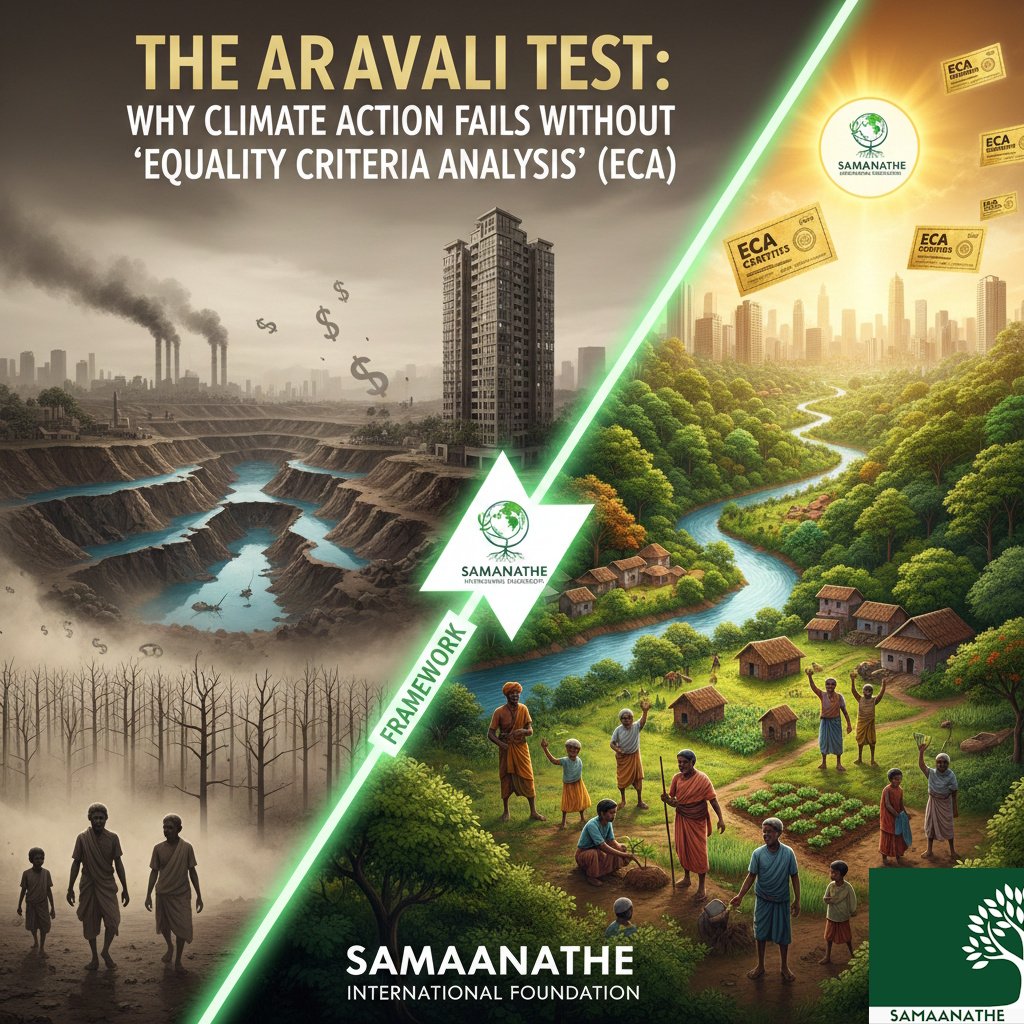
Visualizing the ECA Impact:
| Standard Model | Samaanathe ECA Model |
| Focus: Rapid Tree Planting | Focus: Ecosystem Restoration |
| Beneficiary: Corporations/State | Beneficiary: Local Communities & Earth |
| Outcome: Greenwashing | Outcome: Climate Resilience |
| Value: Low-Quality Credits | Value: Premium “Gold Standard” Credits |
III. Global Respect & The Road Ahead
The Equality Criteria Analysis (ECA) positions Samaanathe International Foundation not just as an NGO, but as a Global Standard-Setting Body.
By adopting ECA, governments and corporations can transform the Aravallis from a “mining pit” into a “Global Climate Heritage Zone.”
- For the Government: Adopting ECA helps India meet its Paris Agreement goals (NDCs) with high credibility.
- For Corporations: Buying “ECA-Certified” credits ensures their CSR funds are not wasted on greenwashing but contribute to verified, high-impact climate action.
The Final Word:
The Aravallis are the test case. If we can save them using the Equality Criteria Analysis, we prove that development does not have to cannibalize the future. Samaanathe International Foundation stands ready to lead this transition, ensuring that when we look at a mountain, we don’t just see a mine—we see our survival.
About The Author